Spotlight 🔍 Atlas Salt
Winter Storms Strengthen the
Investment Case for Atlas Salt
- The recent winter storms exposed how tight the North American de-icing salt market has become, underscoring the need for Atlas Salt’s Great Atlantic Project.
- Great Atlantic is designed to deliver 4 million tonnes of salt per year into an import-reliant market, targeting steady, public-safety-driven demand across Eastern Canada and the U.S. Northeast.
- With environmental approvals secured, early works underway, and strategic partnerships in place, Atlas Salt’s focus now shifts to financing and binding offtake as the key value-driving catalysts.
“In a base case normal year, road de-icing salt is high in demand. The harsh conditions of winter 2026 reinforces the point that there is an opportunity for us to exceed our base case targets.”
— Nolan Peterson, Atlas Salt CEO
The recent winter storms that hit Ontario, Quebec, Eastern Canada, and the Northeastern United States did more than shut down highways.
They exposed how fragile the region’s de-icing salt network has become, as inventories tightened and prices surged, while cities and municipalities scrambled for supplies.
Multiple jurisdictions across Canada and the U.S. were forced to pay premiums, reallocate budgets, limit application, or adjust maintenance plans because fixed salt inventories could not keep up with the winter demand.
For investors, the takeaway was simple. North America’s salt market is tighter than most assumed. For Atlas Salt (TSXV: SALT), the winter storms were delivering its investment thesis in real time.
Atlas Salt is advancing the Great Atlantic Salt Project in Newfoundland, a proposed 4-million-tonne-per-year underground operation designed to serve Eastern Canada and the U.S. Northeast.
In a year when municipalities were competing for limited volumes and paying premiums for spot deliveries, the argument for new, logistics-advantaged domestic capacity became harder to ignore.
Nolan Peterson, the company’s CEO is careful not to overstate a single winter event, but he acknowledges what it represents.
“In a base case normal year, road de-icing salt is high in demand. The harsh conditions of winter 2026 reinforces the point that there is an opportunity for us to exceed our base case targets.”
North America consumes roughly 28 to 36 million tonnes of de-icing salt annually, yet it continues to import an estimated 8 to 10 million tonnes each year. That import dependence works in mild winters. It becomes a vulnerability in severe ones.
When storms hit multiple regions at once, shipping lanes tighten, ports become congested, and inland inventories drain quickly.
For Peterson, that is not a short-term spike. It is structural.
“The salt shortages this year helps with messaging, it helps with marketing, but more importantly it helps in discussions with government groups that are thinking about critical minerals and critical infrastructure,” he said. “Salt should be high on that list.”
Atlas Salt’s Updated Feasibility Study outlines a long-life, large-scale operation with 95 million tonnes of proven and probable reserves grading 95.9% sodium chloride.
The project is designed to generate steady production and consistent revenue rather than depend on short-term market swings. It is expected to have an after-tax net present value of about $920 million, deliver a 21.3% internal rate of return, and produce roughly $188 million in average annual free cash flow after taxes over a mine life of more than 24 years.
Peterson said the updated study has further strengthened the project’s credibility.
“We improved the mine design, incorporated geotechnical drilling, and increased throughput,” he said. “Even with higher capital costs, the project is stronger and more financeable than before.”
The project sits near established infrastructure in Newfoundland, including access to a deep-water port roughly two kilometres from site and proximity to highway and power networks. Shipping times into Boston or New York are measured in days rather than weeks compared to overseas suppliers.
In a commodity where freight can define margins, proximity matters.
Execution has also moved forward since the company’s earlier Top Pick recognition in Muskoka last year. The NI 43-101 technical report supporting the Updated Feasibility Study has been filed, formalizing the economic framework.
Atlas has also expanded its strategic relationship with Sandvik Mining, increasing the scope of equipment and services aligned with construction and ramp-up, including potential vendor-supported financing.
“What began as an equipment supply arrangement has developed into a long-term strategic partnership aligned with construction and decades of expected operations,” Peterson said.
“It supports execution certainty and operational readiness.”
Financing preparation is advancing, with due diligence materials assembled and lender engagement expected to intensify this year. The company has also indicated that bridge capital could accelerate timelines if secured.
“Arranging the project financing is still the big objective,” Peterson said. “Once we know the capital is fully available, we will pull the trigger on the major construction spending.”
Approximately 40% of planned production is already covered by non-binding arrangements, with additional volumes being negotiated across Eastern Canada and the Northeastern United States.
“We don’t think securing the rest will be a problem given what the industry is seeing,” Peterson noted. “The storms may have passed but the supply gap remains.”
Charting Atlas Salt
TSXV: SALT | OTCQX: SALQF
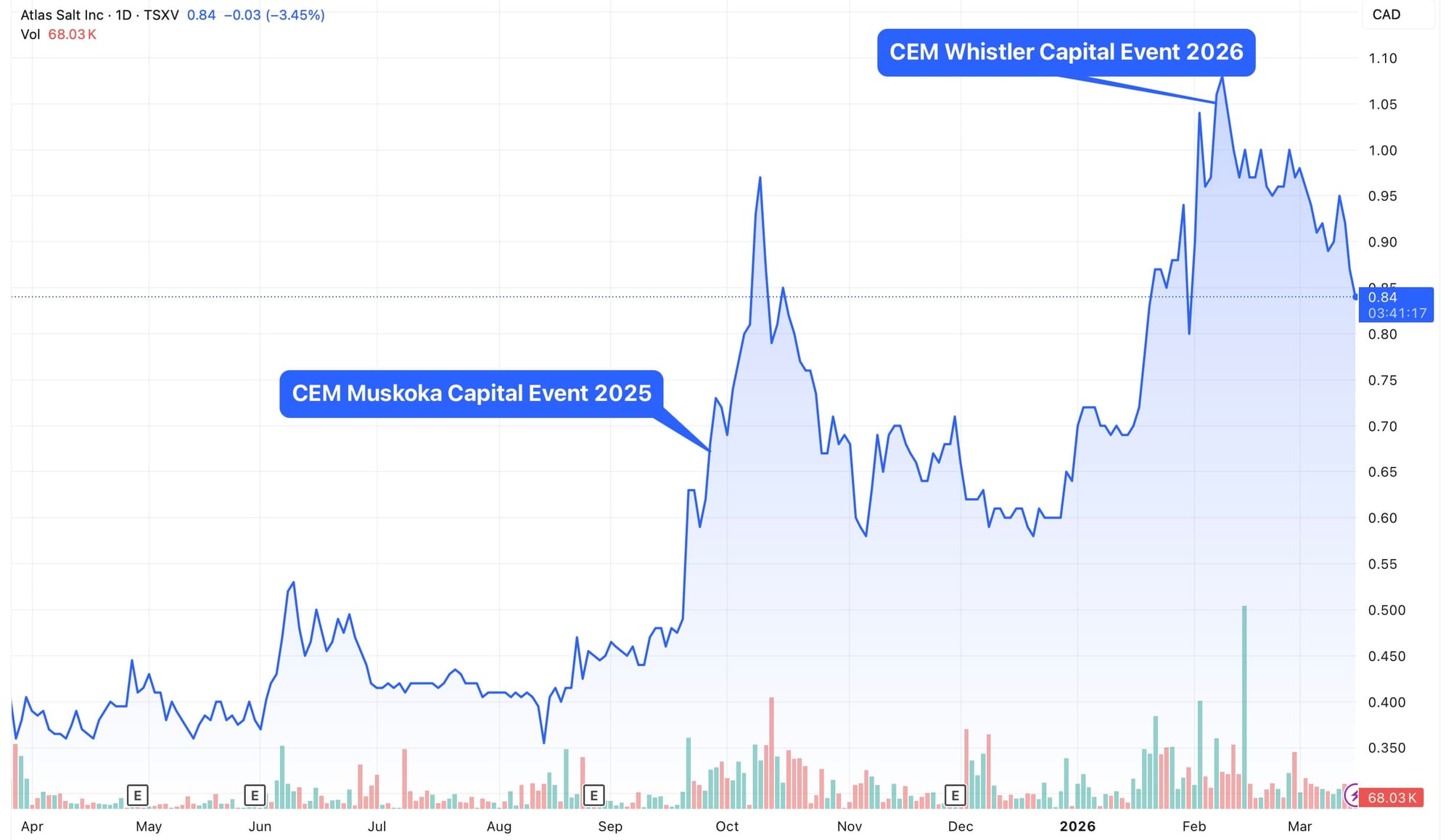
Market Cap¹
Price¹
Picked²
- As of market open on Monday, March 17, 2026
- As of market open on Monday, February 9, 2026 after being selected as a Top Pick at the CEM Whistler Capital Event.
With another Top Pick under its belt, Atlas Salt CEO Nolan Peterson joined us to talk through where the project stands today and what comes next.
Where does the Great Atlantic project stand today?
“We have moved from planning into actual activity on the ground. We satisfied the Environmental Assessment conditions, received the Letter of Release, and that allowed us to start Early Works. The development plan and environmental management plans were approved by the province, and the Benefits Agreement has been executed. With those pieces in place, we are now doing permitted land clearing and site preparation at Great Atlantic.
We are not just talking about the project anymore. We are advancing it. On the technical side, we filed the report that supports the updated feasibility study, so the economics are formally backed. And we expanded our relationship with Sandvik to reflect what construction and ramp-up actually look like under that plan. It is about aligning equipment, execution, and financing so we are ready for the next step.”
What are the next steps for Atlas Salt?
“The big focus now is financing. That’s still the primary objective. We’ve assembled the due diligence package and we’re preparing to engage lenders and infrastructure-focused capital providers. Once we have clarity on the full capital stack, that’s when we move into major construction spending.
At the same time, we’re continuing to advance offtake discussions. We have roughly 40% of planned production covered under non-binding arrangements, and we’re working to convert and expand those. Given what the market just experienced this winter, we don’t see demand as the issue.
We’re also moving forward with early works. Site preparation has started, and that keeps momentum on our side. There’s also the possibility of bridge financing that could allow us to accelerate parts of construction sooner than originally contemplated.
So really, it all centres around securing attractive capital, locking in additional offtake, and turning Great Atlantic into a construction story.”
Once in production, what kind of value proposition do you see for shareholders?
“This is designed to be a long-life, steady cash-flow asset. That’s different from many mining projects that require constant reinvestment just to maintain production.
Once the project is built and debt is managed down, the model supports meaningful free cash flow. That gives us flexibility. We can look at capital returns, reinvestment into mine life extensions, or disciplined growth opportunities. The goal is to build something durable that compounds value over time rather than chasing short-term cycles.”
Our View
- The supply gap is real.
This winter showed how tight the North American salt market has become. With millions of tonnes still imported each year, Great Atlantic’s planned 4 million tonnes per year directly targets a clear and recurring shortage. - Long life. Steady cash flow.
With more than 24 years of mine life and strong projected annual free cash flow, this project is designed to be a durable, income-generating asset tied to essential public safety demand. - Now moving into execution.
Permits are in place, early works have started, and technical studies are filed. The next major step is securing project financing and locking in offtake, which would shift the story from development to construction.
Want to read more about Atlas Salt? See the Spotlight from their Top 5 Pick accolade at the 2025 Muskoka Capital Event!
Warm Regards and Happy Investing,
Fabian Dawson
Weekly Insight
Each week, CEM Partner and Portfolio Manager Ryan Iverson spotlights the ideas and companies sparking investor interest from emerging growth stories to the Top Picks featured across CEM’s Capital Events. This series brings real insights from the innovators shaping tomorrow’s markets and reveals where investors are finding the next breakout opportunities.
Stay informed. Stay ahead. Stay with the Investor Breakout Exchange:
X | Facebook | LinkedIn | Instagram | YouTube | TikTok