Spotlight 🔍 Brazil Potash
Brazil Potash Grows Food Security For A Global Farming Powerhouse
- Brazil Potash’s Autazes Project is positioned to become a meaningful domestic potash supplier, targeting 2.4 million tonnes per year and potentially meeting about 17% of Brazil’s current demand.
- The company is aiming to get potash to local customers in roughly 2.5 days, versus about 107 days for imported supply, which translates into a real delivered-cost advantage and more reliable supply for Brazil’s farmers.
- With 91% of nameplate capacity covered by binding offtake, plus Franco-Nevada’s royalty investment option and applicable tax incentives, Brazil Potash is now working to complete its financing stack by securing an anchor equity partner.
“Brazil is a global food powerhouse, but it still imports about 98% of the potash that keeps its farms running … our Autazes Project is designed to bring that supply home with a shorter, faster logistics chain that can deliver in days instead of months.”
— Matthew Simpson, CEO of Brazil Potash Corp.
Potash has moved from a quiet farm input to a critical resource countries can’t afford to be without, because fertilizer supply is food supply, and food supply is now part of national strategy in every corner of the world.
Nowhere is this more pronounced than in Brazil, which has become one of the world’s most important agricultural economies, yet still imports roughly 98% of the potash it needs to keep its farms productive.
According to current data, Brazil imports roughly US$26 billion a year in fertilizer to support an agricultural economy that generates about US$164 billion in annual exports.
Most of that potash is sourced from a global supply base dominated by a handful of jurisdictions, which is why geopolitics, sanctions, and logistics disruptions can quickly translate into price shocks and delivery delays for growers.
Against this backdrop, Brazil Potash Corp. (NYSE: GRO) is advancing its Autazes Project as a domestic solution aimed at cutting Brazil’s reliance on imported potash, with a supply chain that could deliver product in roughly 2.5 days, versus about 107 days for imported potash.
“The problem with potash is it's an oligopoly. You've got three countries, Canada, Russia, and Belarus, that supply 80% of the world's potash … because we're in Brazil and everyone else is thousands of kilometres away, our cost to extract, process, and deliver is less than just the transportation costs alone for everyone else,” said Simpson.
At its heart, this is a logistics-driven commodity story, and the shortest, simplest route to the customer is what decides who wins, he said.
The Autazes Project in the state of Amazonas is not being pitched as a small supply fix. Brazil Potash believes it can be a long-life, large-scale domestic supplier, with planned initial production of 2.4 million tonnes per year, enough to potentially supply about 20% of Brazil’s current potash consumption.
The company has already invested roughly US$270 million into exploration, technical studies, land acquisition, public hearings, and Indigenous consultation to move Autazes toward construction readiness, in a basin that hosts a measured and indicated mineral resource of about 435 million tonnes grading 31% KCl.
Simpson said the deposit has the kind of runway that could support decades of production, with the potential to expand well beyond what has been drilled so far. “Although we only have 23 years reserves right now, that's based on drilling only ~5% of the ore body … this could be hundreds of years of production,” he said.
That scale and location have pushed Autazes into Brazil’s broader fertilizer security debate, with the government recognizing the project as “nationally important” because of what it could mean for long-term domestic supply.
With the project’s strategic case in place, the next phase is straightforward investor-driven financing to move from early works into full construction.
“The construction capital is estimated at US$2.5 billion with peak funding of US$2.8 billion … we expect to get about $1.8 billion in debt, potentially ~$350 million in third party infrastructure builds, ~$94M tax exemptions, ~$150M from a royalty, and the bulk of the balance in equity via sale of a portion of the Brazilian asset,” he said, outlining a structure that leans heavily on project financing rather than pure equity dilution.
A key part of that strategy is bringing in credible third-party capital at the asset level, including partners that can validate the economics and reduce the burden on public shareholders. Simpson points to Franco-Nevada as a notable signal of that validation. “We have Franco-Nevada … the biggest royalty company in the world. They have an option to invest a further US$150 million in exchange for a 4% royalty,” he said.
On the de-risking side, the company has already secured binding offtake coverage for roughly 91% of nameplate capacity, which matters because it gives lenders and strategic investors confidence that the product has a home before the first tonne is produced.
It has also secured SUFRAMA registration, which is essentially a Brazilian government designation that can unlock tax incentives for qualifying projects in the Amazonas region. Brazil Potash says that could translate into up to US$94 million in construction-phase tax savings, subject to approvals.
For investors watching Brazil Potash in 2026, the key milestone is not another drill result or another macro headline. It is the anchor equity partner that completes the financing stack and unlocks full build mode.
As Simpson put it: “Behind us was getting the construction licenses … ahead of us, it's the anchor equity. That's the linchpin.”
Top Pick Boost for Brazil Potash
NYSE: GRO
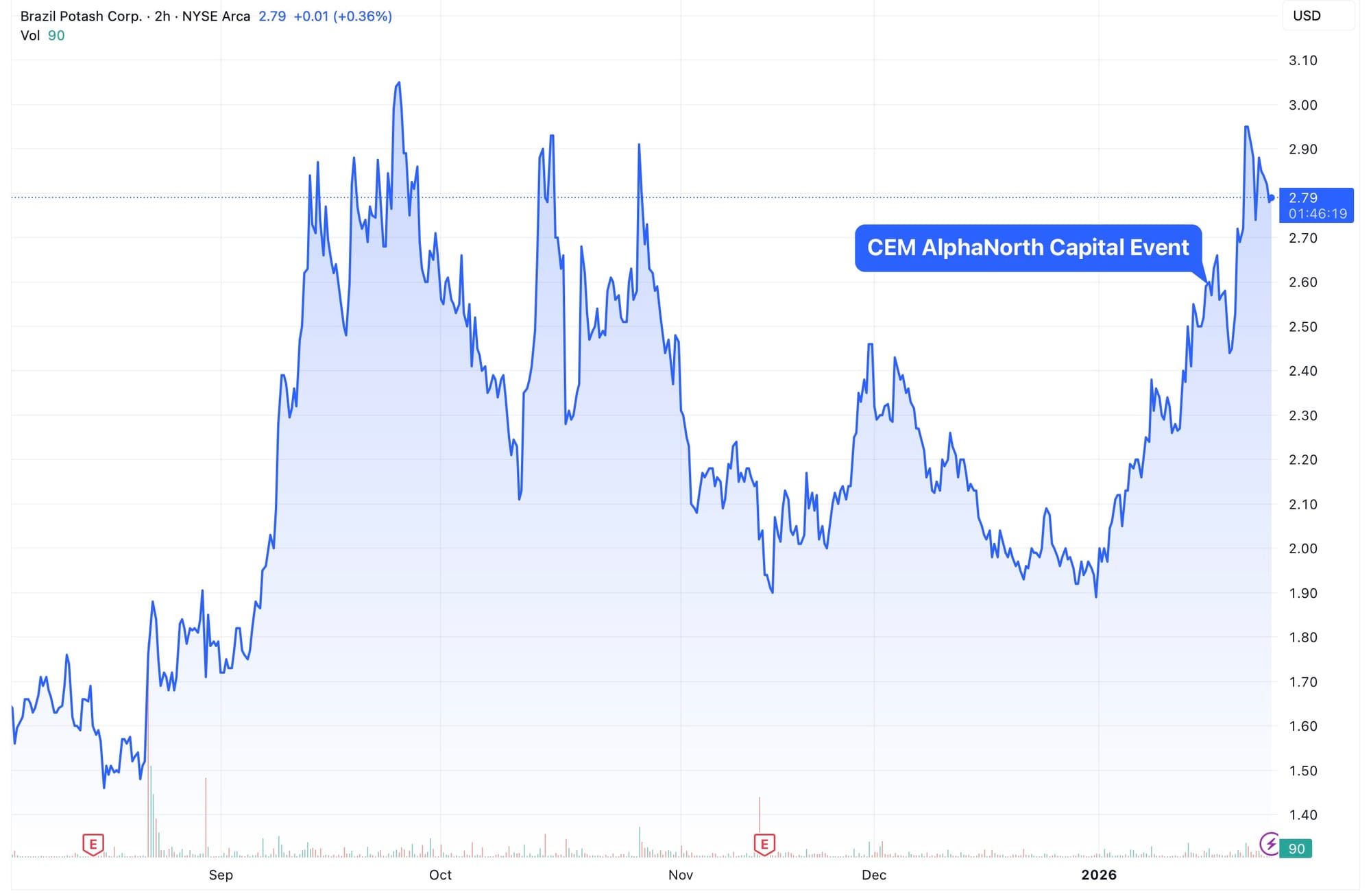
Market Cap
Price¹
Picked²
- As of market open on January 27, 2026
- As of market open on January 20, 2026 after being selected as a Top Pick at the CEM AlphaNorth Capital Event.
The Top Pick in The Bahamas
Coming off its Top Pick selection at the 2026 CEM AlphaNorth Event in the Bahamas, Brazil Potash CEO Matthew Simpson walked us through the company’s strategy, key project milestones, and why investors are leaning in.
Question #1: When you say Autazes is moving toward construction, what does that actually mean on the ground today, and what should investors expect next?
“When I talk about construction readiness, I’m talking about a project that’s already moved past the ‘idea stage.’ We’ve been doing early construction works, and that’s meant real, visible progress at site, both at the future plant location and at the port area. We’ve cleared the ground and prepared the footprint so we’re ready once the next phase kicks in.
The next major step is front-end engineering design. That’s where you take a permitted project and you turn it into something you can actually build, with engineering detail that supports long-lead procurement, sequencing, and the level of technical confidence that lenders and strategic partners need.
And I’ll add this because it matters for perception. People hear “Mining in the Amazonas State” and they assume massive disturbance of rainforest. The reality is the footprint is not enormous. It’s a compact, defined industrial footprint, underground mine with dry stacked tailings being constructed on former cattle farming land.”
Question #2: How are you thinking about Indigenous engagement and social license, and what should investors understand about that process?
“I know investors want to understand this file clearly, and they should. The first thing I’ll say is that even though our current reserves and permits are not located under Indigenous land, we still chose to follow the United Nations protocols for free, prior and informed consultation. I didn’t want this to be a box-checking exercise. I wanted it to be durable.
That process took us seven years. It was extensive. It wasn’t just one community or one meeting. It involved dozens of reserves in the region, including communities that are a long distance from the project. At the end of it, we had broad participation and a strong mandate to proceed, with high turnout and a strong vote from the local Indigenous communities in favour of the project.
For me, the key point is that support has to be earned and maintained. That means we’re not just talking about benefits in the future. We’re working on real initiatives today, and we’re building relationships that can last through construction and into operations.”
Question #3: What is your plan to finance Autazes in a way that gets it built while protecting shareholders from excessive dilution?
“This is a big project, so I’m not going to pretend otherwise. At peak funding, we’re looking at roughly $2.8 billion, and we expect about $1.8 billion of that to come from debt, ~$350 million from third party infrastructure builds, ~$94 million tax exception and ~$150 million royalty, with the balance largely equity from sale of a portion of the company in Brazil. That tells you how we’re thinking about it. This is project financing. It’s not just equity raises forever.
A big part of our strategy is to bring in credible third-party capital at the asset level, and that matters for two reasons. One, it validates the project. Two, it reduces the burden on public shareholders. That’s why having a group like Franco-Nevada involved is meaningful. They’re the biggest royalty company in the world, and they have an option to invest a further US$150 million in exchange for a 4% royalty.
We’re also focused on finding ways to fund discrete components of the project through third parties. The idea is to carve out infrastructure and remove pressure from the core CAPEX, wherever we can, so the financing stack is more efficient and less dilutive.
For instance, we’ve already signed an MOU with Fictor Energia for roughly US$200 million in power line construction funding, which effectively takes that cost out of the project’s CAPEX and helps us keep more of the core build focused on the mine and processing plant.
And for investors watching us in 2026, I’m very clear on what matters most. The anchor equity partner at the project level is the linchpin. Once that’s in place, everything accelerates, because it’s the piece that unlocks full build mode.”
Our View
- A national-scale problem with a clear, local solution
Brazil is a global agricultural powerhouse, but it still imports roughly 98% of the potash that keeps its farms productive. Autazes is a rare project built specifically to close that gap with meaningful scale, targeting 2.4 million tonnes per year and potentially supplying about 17% of Brazil’s current potash demand. - Logistics is the edge, and it’s structural
Potash is a critical mineral bulk commodity, and the winner is usually the company that can deliver cheaper and faster. Brazil Potash’s pitch is that domestic supply can compress delivery timelines dramatically, with company estimates of roughly 2.5 days versus about 107 days for imported potash, which can translate into real pricing power at the delivered-cost level. - De-risking is showing up in contracts and real milestones
This isn’t a “wait and see” exploration story. Brazil Potash has binding take-or-pay offtake contracts covering about 91% of nameplate capacity, and it has secured SUFRAMA registration, which is essentially a Brazilian government designation that can unlock tax incentives for qualifying projects in the Amazonas region. Brazil Potash says that could translate into up to US$94 million in construction-phase tax savings, subject to approvals. Add the planned infrastructure carve-outs and the push for anchor equity in 2026, and the company’s pathway to full construction looks increasingly financeable.
Upcoming: Whistler Capital Event
February 6–8, 2026
CEM heads back to the mountains for its 16th Annual Whistler Capital Event, hosted at the Fairmont Chateau Whistler from February 6th to 8th, 2026. This is where growth-stage companies across resources, technology, biotech, and special situations get direct access to serious capital, not through a crowded conference floor, but through a full day of scheduled one-on-one meetings and high-quality networking. If Bahamas was about identifying who looks ready, Whistler is where those conversations often turn into real momentum.
Warm Regards and Happy Investing,
Fabian Dawson
Weekly Insight
Each week, CEM Partner and Portfolio Manager Ryan Iverson spotlights the ideas and companies sparking investor interest from emerging growth stories to the Top Picks featured across CEM’s Capital Events. This series brings real insights from the innovators shaping tomorrow’s markets and reveals where investors are finding the next breakout opportunities.

Stay informed. Stay ahead. Stay with the Investor Breakout Exchange:
X | Facebook | LinkedIn | Instagram | YouTube | TikTok