Spotlight 🔍 Brazil Potash
Investor Interest Builds As Brazil Potash Moves From Permits To Project Financing
- Brazil Potash is more than a food-security thesis as the construction and finance team advance its Autazes Project designed to produce 2.4 million tonnes a year and supply about 17% of Brazil’s potash needs.
- Given the committed offtakes and the high margins, the project can easily support the projected $1.5–$1.8 billion construction loan.
- The company is considering innovative financing alternatives for the estimated US$2.5 billion build, through about US$400 million in BOOT infrastructure carve-outs, roughly US$94 million in potential tax concessions, already negotiated the $150 million royalty with Franco Nevada, and possible asset-level equity joint ventures.
- Investors are now watching for FEED progress, construction debt and partner commitments needed to move Autazes into full build mode, with 91% of nameplate capacity already covered by offtake agreements.
“Maybe for the first time in the project’s history … all stakeholders are completely aligned … they just want to see this thing built”
— Chris Naprawa, Advisor for Brazil Potash
Brazil is one of the world’s most important agricultural economies, yet it still relies on imports for more than 95% of its potash supply, a dependence that looks increasingly untenable in a world shaped by sanctions, shipping disruption, and food-security politics.
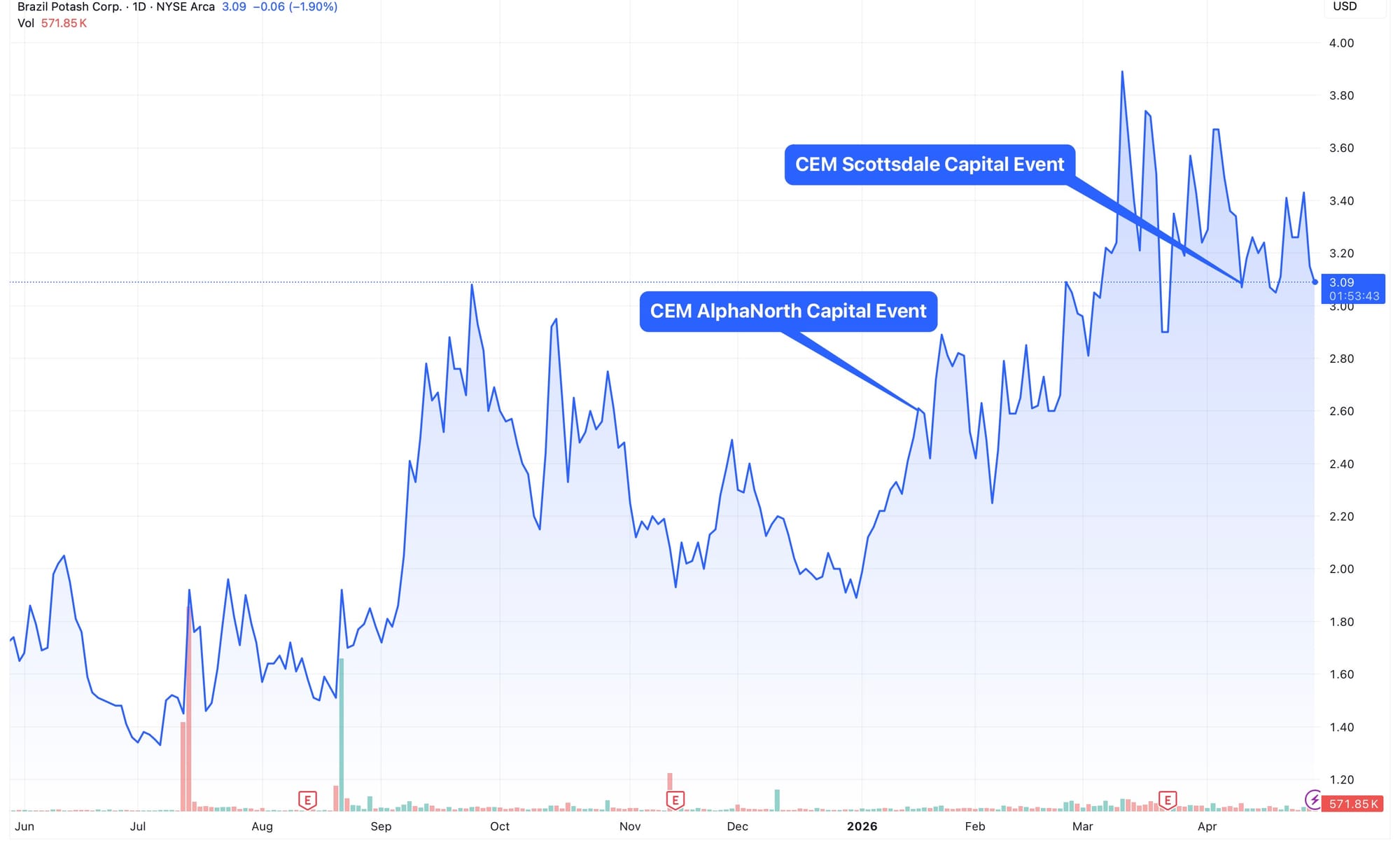
That supply gap sits at the centre of Brazil Potash Corp.’s investor pitch, which gained another lift at the recent 2026 CEM Scottsdale Capital Event when the company was named a Top Pick for the second time this year.
“Last year was all about off-take agreements and permits, and this year is all about project financing and starting construction” said Chris Naprawa, Advisor for Brazil Potash.
Brazil Potash is advancing its Autazes Project as a long-life underground mine located inside the market it is meant to serve. The company says Brazil accounts for 22% of global potash demand, produces less than 1% of global potash supply and remains about 98% reliant on imports. It also says Brazil’s agriculture sector generated more than 23% of the country’s 2024 GDP, while agricultural exports reached US$164 billion.
Autazes is designed to produce 2.4 million tonnes per year, enough to supply roughly 17% of Brazil’s potash consumption.
Naprawa said the logistics case remains central to the Brazil Potash story because Autazes will deliver potash to Brazilian customers in about 2.5 days, compared with roughly 107 days for imported supply, while cutting transportation costs by about 71% versus foreign competitors.
That advantage is important because Autazes is a large project with a large financing requirement. The company estimates it will cost about US$2.5 billion to reach full production. Once operating, Autazes is expected to generate about US$1 billion in annual run-rate EBITDA, with a current reserve life of 23 years and room for expansion.
To reduce pressure on the core financing package, Brazil Potash is looking to carve out several infrastructure components through BOOT structures, short for build, own, operate and transfer. In simple terms, that means third-party partners could fund and operate certain pieces of the project before transferring them back under agreed terms.
Those segments include:
Power line — The power line would supply electricity needed for construction and future operations. Company materials referenced a roughly US$200 million power-line funding structure, which would help remove a major infrastructure cost from the core project budget.
Steam plant — The steam plant would support the processing operation. By separating it from the mine-and-plant build, Brazil Potash can look for a specialist infrastructure partner to finance and operate that piece.
Port — The port is a key part of the logistics chain. It would help move potash from Autazes into Brazil’s domestic fertilizer distribution network, supporting the company’s faster delivery and lower-cost argument.
Trucking from plant to port — This covers the short-haul link between the production site and the port. The company has described this as an eight-mile route, making it a defined infrastructure package that could be funded separately.
Construction and backup power — Backup power would help keep the build moving and reduce reliability risk during construction and early operations. For a large project entering the next stage, that matters because delays can quickly add cost.
Together, Naprawa said these BOOT-style carve-outs could account for about US$400 million of capex.
“We want to keep more of Brazil Potash’s capital focused on the core mine and processing plant, reduce dilution risk for shareholders and make the overall financing stack easier to complete,” said Naprawa.
“We’ve got an all-in sustaining cost of $79 a ton, and we’ve got a sale price approximately $450, so we’re making software-style margins on a materials project,” he said, adding commercial de-risking already in place.
The company’s latest investor presentation says offtake contracts cover 91% of nameplate capacity, including agreements with Amaggi, Keytrade, and Kimia Agro Solutions. The deck also lists recently delivered milestones that include a binding offtake agreement with Keytrade, a binding offtake agreement with Kimia Solutions, the start of early works construction. and 13 memorandums of understanding for local community training.
The next set of milestones is more finance-driven. They include tax concession negotiations amounting to about US$94 million in potential construction-phase tax savings, an equity partner at the asset level and construction debt as major items to watch.
“The last thing that we need to do to nail down the debt for the project is the front end engineering and design … and we’ll award that contract very soon as well,” he said.
“Maybe for the first time in the project’s history … all stakeholders are completely aligned … they just want to see the thing built,” said Naprawa.
Charting Brazil Potash
NYSE: GRO
Market Cap
Price¹
Picked²
- As of market open on Wednesday, April 29, 2026.
- As of market open on Monday, April 13 after being selected as a Top Pick at the CEM Scottsdale Capital Event 2026.
Chris Naprawa, Advisor for Brazil Potash provides an update on the company in this Q&A with the IB Newsletter
What should investors be watching most closely over the next few months?
“The clearest thing to watch is how we turn the pieces of the financing plan into signed commitments. The project has moved well beyond the early-stage mining story. The permits, offtakes, community work, and early construction all help, but the market is now looking for the next hard proof points.
That means progress on the FEED (Front-End Engineering and Design) contract, the BOOT packages, the asset-level equity partner, and the construction debt. Each one matters on its own, but together they show how we can move from a permitted project into a financed build.”
Why does FEED matter so much?
“FEED is the engineering step that helps make the project bankable. It gives lenders and partners more detail on costs, procurement, construction timing and execution risk. For Brazil Potash, advancing FEED is one of the practical steps needed to support the larger debt package.”
What is the bigger message Brazil Potash wants investors to take away now?
“The message is that Autazes is becoming less about future potential and more about execution. Brazil needs potash. The customers are there. The import dependence is clear. The project has commercial support through offtakes, and the cost advantage is tied to location.
The next test is delivery. Brazil Potash has the size, scale, and an established end market that more than justifies the financing requirement. The project is essential, and the time-line for payoff is very attractive”
Our View
- Brazil Potash has already made the case for why Autazes matters. The sharper question now is how the company funds a US$2.5 billion build in a way that preserves shareholder upside. The bulk of the capex will be satisfied with a construction loan easily supported by the projects economics. Building on that base of financing, asset-level equity, construction debt and partner-backed infrastructure is a real investor focus.
- The planned carve-outs for power, port, steam, trucking and backup power are more than accounting details. If Brazil Potash can shift about US$400 million of project costs into third-party infrastructure packages, it could reduce the amount of capital the company needs to raise directly and make the financing stack easier to complete.
- The import-dependence argument is already well understood. What matters next is FEED advancement, tax concessions, infrastructure commitments, construction debt, and an equity partner at the project level. Those are the signals that would show Autazes is moving from a compelling plan to a buildable project.
Upcoming
Bermuda Capital Event
June 12–14, 2026
CEM now turns to the 3rd Annual Bermuda Capital Event, which will be held June 12–14 at the Fairmont Hamilton Princess & Beach Club. The event will once again connect growth-stage issuers in resources, technology, biotech, and special situations with active senior capital markets professionals through a full day of scheduled one-on-one meetings.
Warm Regards and Happy Investing,
Fabian Dawson
Weekly Insight
Each week, CEM Partner and Portfolio Manager Ryan Iverson spotlights the ideas and companies sparking investor interest from emerging growth stories to the Top Picks featured across CEM’s Capital Events. This series brings real insights from the innovators shaping tomorrow’s markets and reveals where investors are finding the next breakout opportunities.
Stay informed. Stay ahead. Stay with the Investor Breakout Exchange:
X | Facebook | LinkedIn | Instagram | YouTube | TikTok