Spotlight 🔍 ReconAfrica
ReconAfrica’s KW1X Well Puts Namibia’s Onshore Energy Sector on the Map
- Basin-opening well confirms the most compelling evidence yet for onshore oil and gas potential in Namibia.
- An early-2026 production test will determine whether the well can move to a proven play, with meaningful valuation implications.
- The new drilling result is likely to accelerate evaluation and follow-up work across ReconAfrica’s broader Namibia, Angola, and Gabon projects
Namibia’s rise as an emerging oil and gas jurisdiction has been powered largely by deepwater offshore discoveries that put the African country firmly on the global energy map.
That story is now expanding on land, where Reconnaissance Energy Africa (TSXV: RECO) has delivered the clearest technical evidence yet that onshore Namibia could evolve into a meaningful second pillar of the country’s energy economy.
The company announced this week that drilling at its Kavango West 1X well in northeastern Namibia intersected a thick hydrocarbon-bearing interval within the Otavi carbonate formation, a layer of ancient limestone formed hundreds of millions of years ago.
The company said in a statement:
- The well encountered ~400 metres (~1,300 feet) of gross hydrocarbon section identified on wireline logs in the Otavi carbonate section.
- The well encountered 64 net metres (210 feet) of hydrocarbon pay, verified by wireline logs and supported by mud log anomalies.
- An additional 61 metres (200 feet) of hydrocarbon shows identified in the deeper sections, where interpreted natural fractures in the limestone reservoir occur.
This is the first time hydrocarbons have been identified in the Damara Fold Belt onshore Namibia within rock layers that meet the technical standards required for potential commercial production, said Mark Friesen, Vice President of Investor Relations for ReconAfrica.
“This well opens an entirely new basin… It is the strongest signal the industry has seen to date for oil and gas onshore in Namibia and today we are the primary company actively exploring onshore in the country,” said Friesen.
The African Energy Chamber (AEC) said the latest Kavango results represent one of the most meaningful milestones yet for the country’s onshore energy potential.
“This is a big win for Namibia and a big win for Africa. ReconAfrica’s progress is proof that committed investors, supportive policies and strong community partnerships can unlock real energy opportunities onshore,” said NJ Ayuk, Executive Chairman of the AEC.
ReconAfrica’s Shares Soar
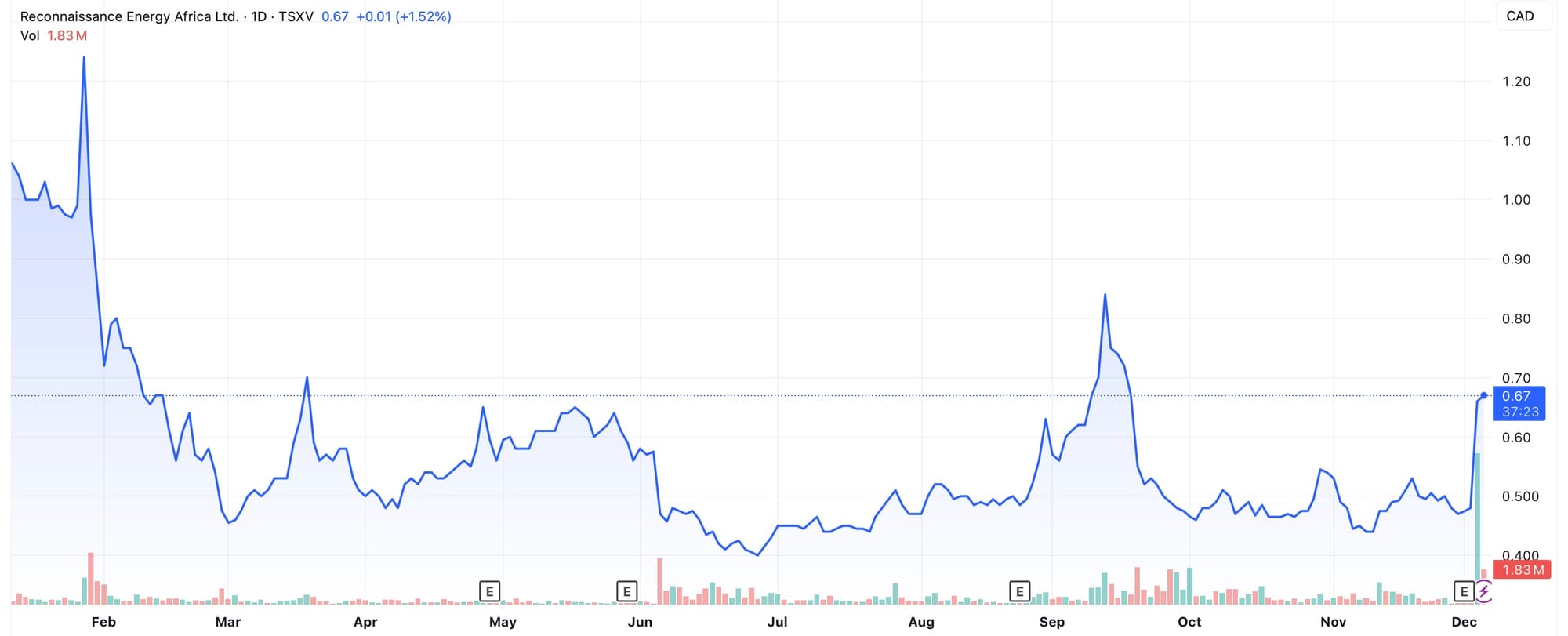
Market Cap
Price¹
- As of market open on December 4, 2025
What ReconAfrica is Building
The Kavango result also reflects the company’s broader strategy. ReconAfrica is focused on large, underexplored African sedimentary basins, deliberately pairing frontier onshore exploration with assets that offer clearer paths to development and cash flow.
In Namibia, the company controls roughly six million acres across the Damara Fold Belt and Kavango Rift Basin. Internal and independent work has identified 19 structurally similar prospects, suggesting repeatable exploration potential if commercialization is proven.
Beyond Namibia, ReconAfrica holds approximately five million contiguous acres onshore in southeastern Angola, where it sees geological continuity with its Namibian acreage. It also operates a shallow-water offshore block in Gabon that already hosts an oil discovery close to existing infrastructure. Gabon provides nearer-term development optionality, while Namibia and Angola offer larger-scale exploration upside.
Together, these assets give the company portfolio balance rather than reliance on a single binary outcome.
A Reset in Leadership and Approach
ReconAfrica’s positioning today follows a corporate reset that began in 2023. While the company has operated in Namibia for nearly a decade, leadership views the past two years as transformational.
“The story really changed when a new management team came in under Brian Reinsborough,” Friesen said.“There was a deliberate rebuild of leadership, stronger governance, and a much more technically driven approach.”
That reset is central to investor messaging as the company moves from early-stage exploration into appraisal-driven execution.
Why Onshore Matters in Namibia
The Kavango result lands at a moment when offshore Namibia is drawing intense comparisons to Guyana, where recent deepwater discoveries have already been converted into several hundred thousand barrels per day of production. Deepwater discoveries in the Orange Basin, located roughly 200 to 300 kilometres off Namibia’s southern Atlantic coast in water depths of about 1,500 to more than 3,000 metres, are expected to underpin the country’s first commercial oil production.
But Friesen argues onshore economics offers a fundamentally different value proposition. Onshore wells can typically cost from a few million dollars up to more than US$15 million per well, depending on the basin and design.
“Offshore, especially in deepwater, costs several times that. And if an onshore well works, you can move to production far faster than a ten-year, deepwater cycle,” said Friesen.
That shorter cycle affects capital efficiency. “If an onshore well proves commercial, you can install surface equipment and be moving oil to market in trucks within months, not years like deepwater offshore.”
Operating onshore also shapes ReconAfrica’s relationship with Namibia’s government and local communities.
“We have a very strong relationship with the Namibian government,” Friesen said. “Because we’re working onshore in visible communities, we invest heavily in scholarships, water wells, jobs and social programs. The government views this as a model for how oil and gas companies should operate.”
That support translates into regulatory stability and political access, both critical for long-dated energy investments in frontier jurisdictions.
Energy Transition Realism
ReconAfrica does not position its work as opposition to the energy transition.
“I’m a strong supporter of renewables,” Friesen said. “I have solar on my own roof and even wrote a book about solar. But oil and gas are not disappearing quickly, and countries like Namibia should be allowed to benefit from responsible development, just as regions like Alberta and Texas did.”
From ReconAfrica’s perspective, revenues generated from early production in Namibia can help fund investments in power infrastructure, electrification and lower-carbon technologies.
For investors, the story now converges on a defined milestone...
ReconAfrica has already cleared the geological hurdle by confirming hydrocarbons onshore for the first time in Namibia’s history. The planned production test in early 2026 will determine whether that geology translates into commercial deliverability.
“A successful production test would move this from an unproven exploration idea to a proven play,” Friesen said. “Investors would reasonably expect that to have major value implications.”
Warm Regards and Happy Investing,
Fabian Dawson
2026 Event Schedule
Register today to see if you qualify to attend!
AlphaNorth Capital Event (Bahamas): January 16-18, 2026
Whistler Capital Event: February 6-8, 2026
Scottsdale Capital Event: April 10-12, 2026
Bermuda Capital Event: June 12-14, 2026
TSX Venture Growth Capital Event (Okanagan): July 17-19, 2026
Muskoka Capital Event: September 25-27, 2026